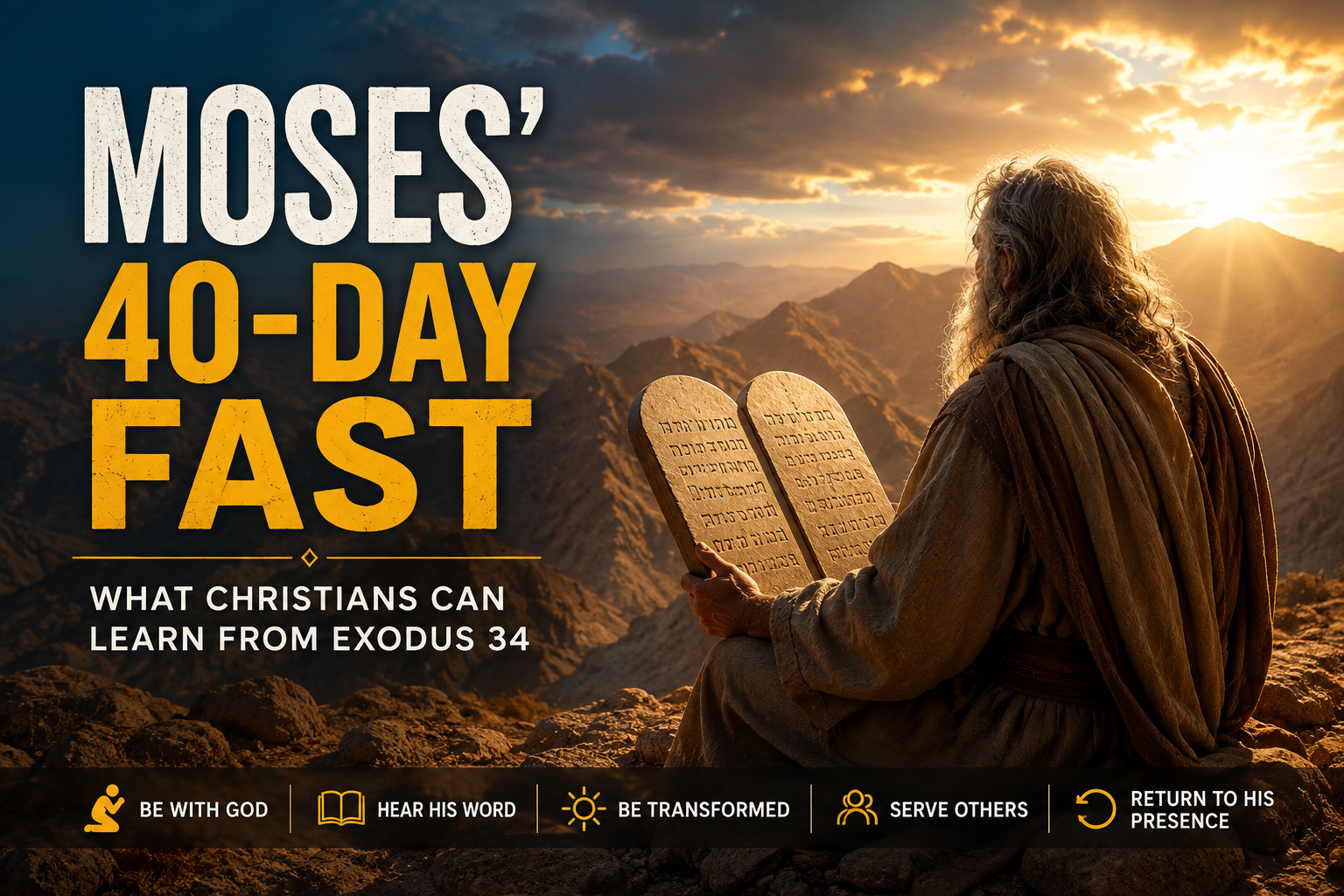
Moses’ 40-day fast is one of the most extraordinary fasts recorded in the Bible.
Exodus 34:28 says:
“And he was there with the Lord forty days and forty nights; he did neither eat bread, nor drink water.”
Forty days. Forty nights. No food. No water.
But if all we take away from this passage is how long Moses went without food, we will miss the most important part of the story.
The verse begins:
“And he was there with the Lord…”
That is what I want us to pay attention to.
Moses was not simply trying to survive 40 days without eating. He was with God.
And by the time he came down from that mountain, he was carrying God's Word and his face was shining.
So what can Christians learn from Moses’ fast?
How Long Did Moses Fast?
Moses fasted for 40 days and 40 nights on Mount Sinai.
According to Exodus 34:28, he ate no bread and drank no water during that period.
This was an extraordinary biblical event. It should not be treated as a normal fasting plan for Christians to copy.
I would never tell someone:
“Moses did 40 days without food or water, so you should try it.”
No.
Moses was in a unique situation. God had called him onto the mountain, and the passage records something extraordinary happening between Moses and God.
The lesson is not:
Try to reproduce Moses’ physical fast.
The lesson is:
Look at what happened while Moses was with God.
That is where the real teaching is.
Why Did Moses Fast for 40 Days?
Exodus 34 does not present Moses as announcing a 40-day fasting challenge.
God called Moses into His presence.
While there, Moses received the words of the covenant.
Exodus 34:28 continues:
“And he wrote upon the tables the words of the covenant, the ten commandments.”
So Moses’ time on the mountain involved at least two major things:
communion with God and receiving from God.
That gives us our first major lesson about biblical fasting.
1. Fasting Should Be a Time of Being With God
This may be the most important thing Christians need to understand about fasting.
You can stop eating without seeking God.
That does not automatically make the experience spiritually meaningful.
When I fast, the food I am not eating should create space for something else.
Prayer.
Scripture.
Seeking God.
Listening.
Reflection.
Worship.
The point is not simply:
“I didn't eat today.”
The question is:
“What did I do with the time and attention that fasting created?”
Moses was with the Lord.
That should shape the way we approach fasting.
When you fast, turn your attention toward God.
2. Fasting Is an Opportunity to Receive From God
Moses did not come down from the mountain empty-handed.
He came down carrying the tablets containing God's covenant.
He had received something.
That does not mean every time you fast God is going to give you some dramatic new revelation.
But fasting gives us an opportunity to become more intentional about listening.
You may become convicted about something in your life.
A Scripture may become clearer.
You may recognize something you need to change.
You may receive clarity about a decision.
You may realize that God has already been speaking through His Word, but you have been too distracted to pay attention.
This is one reason Scripture should be central during fasting.
Don't only stop eating.
Open your Bible.
Read slowly.
Meditate.
Pray through what you're reading.
Ask:
“Lord, what are You showing me?”
During the broadcast, this was one of the central lessons I drew from Moses receiving the covenant while he was on the mountain.
3. Moses Came Out of God's Presence Changed
Then something remarkable happened.
Exodus 34:29 says Moses came down from Mount Sinai and:
“the skin of his face shone.”
Moses himself did not even realize it at first.
Aaron and the Israelites saw it.
That is powerful.
Moses had spent time with God, and something about that encounter became visible.
Again, I don't believe we should read this and conclude:
“If I fast correctly, my face will literally shine.”
That misses the point.
The broader principle is transformation.
When we spend serious time seeking God, we should desire to come away changed.
Perhaps:
you become more humble.
You forgive somebody.
You recognize an area of sin.
Your priorities change.
Your appetite for Scripture grows.
Your prayer life deepens.
You receive clarity.
You become more obedient.
There should be more to the end of a fast than simply being excited that you can finally eat.
The better question is:
What has God been doing in me?
4. Sometimes Other People Notice the Transformation Before You Do
There is another interesting detail in Exodus 34.
Moses did not know his face was shining.
Other people noticed it.
I find that significant.
Sometimes genuine spiritual transformation is not something you need to advertise.
People begin to see it.
Your patience changes.
Your response to pressure changes.
Your priorities change.
Your speech changes.
Your relationship with God affects the way you live around people.
Moses came down carrying evidence that he had been somewhere.
And the place he had been was with God.
That is something I want Christians to desire when fasting.
Not merely:
“I completed three days.”
But:
“I spent time with God, and something in me is different.”
5. Moses Came Down With Something for Other People
Moses didn't stay on the mountain.
He came down.
And when he came down, he gave the Israelites what God had commanded him.
Exodus 34:32 says the Israelites came near and Moses:
“gave them in commandment all that the Lord had spoken with him in mount Sinai.”
That means Moses’ encounter with God was not merely for Moses.
It eventually benefited the community.
That is another lesson for us.
Your spiritual life should not terminate on you.
If God is developing patience in you, somebody else should eventually experience that patience.
If God gives you wisdom, use it to serve.
If God corrects you, live differently.
If Scripture opens your eyes to something, obey it.
Sometimes you may even come out of a season of fasting with a responsibility you did not have before.
Moses came down with both transformation and responsibility.
6. Don't Become Distracted by Spiritual Experiences
When the Israelites saw Moses’ shining face, they were afraid to approach him.
Eventually Moses put a veil over his face.
One lesson I take from this is that the extraordinary manifestation did not become Moses’ message.
He still had work to do.
He still had God's commandments to communicate.
He did not make the shining face the whole point.
That matters.
During fasting, you may experience powerful emotions.
You may experience unusual clarity.
You may feel God's presence deeply.
You may have dreams.
You may experience answers to prayer.
Thank God for those things.
But don't become so fascinated by experiences that you forget the purpose:
knowing God, becoming more like Him and obeying Him.
The experience must never become greater than the God you are seeking.
7. Moses Kept Returning to God's Presence
One of my favorite parts of the passage comes toward the end.
Exodus 34:34 says:
“But when Moses went in before the Lord to speak with him, he took the veil off…”
Notice the pattern.
Moses goes before God.
He comes out.
He serves the people.
And he goes back before God again.
That is important because fasting should not become a one-time spiritual achievement.
You should not say:
“I fasted for three days in 2026. I have done fasting.”
No.
The goal is to develop a life in which seeking God becomes normal.
This is one of the ideas behind Practice Weekend.
The purpose is not simply to help somebody survive one weekend without food.
It is to teach the discipline until you can practise it yourself.
You may join us this weekend.
You may fast again another weekend.
Eventually you should not need somebody online telling you to fast.
You know how to seek God yourself.
That repeated return to God's presence is one of the things I see in Moses’ story.
Should Christians Try Moses’ 40-Day Fast?
No Christian should read Exodus 34 and conclude that going 40 days without food and water is the biblical standard for fasting.
It isn't.
Moses’ experience was extraordinary.
The Bible records fasts of different lengths and different types.
So don't measure the seriousness of your Christianity by whether you can reproduce Moses’ 40 days.
And don't turn fasting into competition.
The question is not:
“Who can do the hardest fast?”
The question is:
“Am I genuinely setting myself apart to seek God?”
Start where you can start wisely.
The spiritual value of a fast is not determined simply by how extreme the food restriction is.
What Should You Do During a Christian Fast?
If we take Moses’ example seriously, I would keep it simple.
When you fast:
Be with God.
Read Scripture.
Pray.
Reduce unnecessary distractions.
Pay attention to what God may be exposing in your heart.
Write down what you are learning.
Obey what Scripture shows you.
And don't spend the entire fast thinking about when you are going to eat again.
Use the hunger as a reminder:
“I am setting this time apart to seek God.”
Psalm 63 captures that attitude beautifully:
“My soul thirsteth for thee, my flesh longeth for thee in a dry and thirsty land…”
That is why I like Psalm 63 as a Scripture for beginning a fast.
Physical hunger can remind us of a deeper hunger:
I want God.
The Real Lesson of Moses’ Fast
When I read Exodus 34, the lesson I see is not:
Moses was impressive because he survived 40 days.
It is:
Moses was with God.
He received from God.
He came away changed.
Others could see the transformation.
He carried God's Word back to the people.
And he kept returning to God's presence.
That is the kind of fasting I want to learn.
Not fasting as an endurance contest.
Not fasting as a way to force God to answer me.
But fasting as intentional time to humble myself, turn my attention toward God, hear His Word more clearly and allow Him to work in me.
And when the fast is finished, I should not merely ask:
“When can I eat?”
I should also ask:
“What am I carrying out of God's presence?”